A worldwide network of bulletin board systems — built by hobbyists, run on phone lines, and operating years before the public web existed.
At its peak, FidoNet connected over 40,000 nodes across 6 continents.
1984Founded
~40kPeak Nodes
6Zones (Continents)
$0Cost to Users
2400Typical Baud Rate
What Was FidoNet?
A volunteer-run global network — before the web existed
In 1984, a software developer named Tom Jennings wrote a bulletin board system program called Fido.
Almost as an afterthought, he added code that let two Fido systems automatically call each other over ordinary telephone lines
to exchange messages while the phone rates were cheapest — usually in the middle of the night.
Within months, other sysops (system operators) had connected their BBSs to his.
Within years, this informal network had grown to span the globe. That network was FidoNet.
FidoNet operated entirely through store-and-forward messaging: messages were composed offline,
bundled into packets, and transferred node-to-node like a digital postal system — each node passing mail
along until it reached its destination. There was no central server, no corporate owner, no monthly fee.
Just thousands of ordinary people running computers in their homes and offices, connected by modems and phone lines.
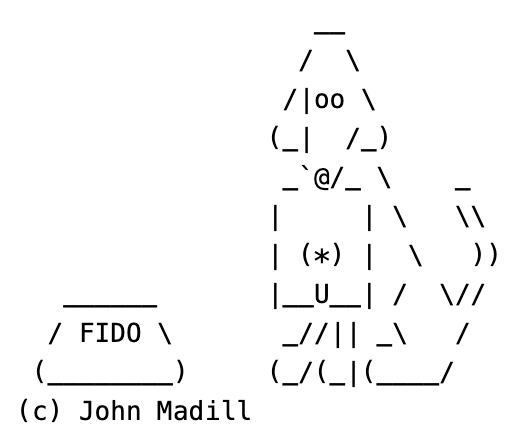
The FidoNet Logo — Tom Jennings' original mascot: a dog carrying a floppy disk. The name "Fido" came from the idea of a faithful dog that would reliably carry messages for you.
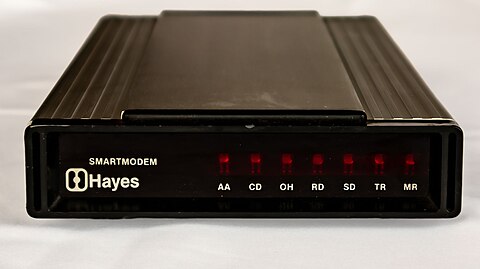
Hayes Smartmodem (1982) — The modem that made FidoNet possible. The "AT command set" it introduced became the industry standard. A 1200-baud unit could transfer about 120 characters per second — roughly one printed page per minute.
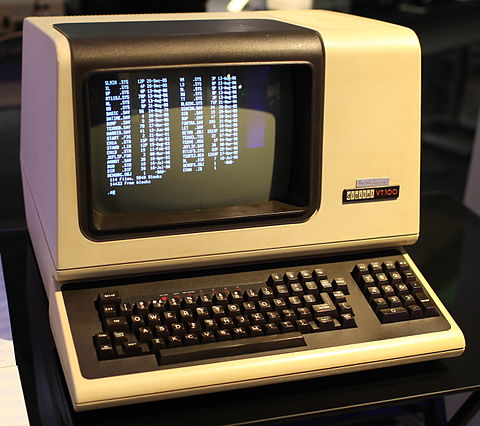
DEC VT100 Terminal (1978) — The terminal standard that shaped BBS interfaces. Its 80×24 text display and ANSI escape codes defined how users saw BBS menus, message boards, and FidoNet mail.
"The idea was basically: here's this address system, here's this packet format, and anybody who wants to implement it can. And people did."
— Tom Jennings, FidoNet creator
What It Was
A hierarchical peer-to-peer network of bulletin board systems exchanging email (Netmail) and public discussion groups (Echomail) via dial-up modem connections, coordinated by volunteer administrators.
Who Ran It
Ordinary hobbyists called sysops (system operators), each running a BBS on a personal computer in their home or office — often on a second phone line. No salary, no company backing.
How Mail Moved
Nodes called each other (or their regional hub) once or twice per day — often at 2–3 AM for cheap phone rates — to exchange bundled message packets. Mail could take 24–72 hours to traverse the globe.
Scale at Peak
By the early 1990s FidoNet had over 40,000 active nodes, processing millions of messages per day across 6 geographically-defined zones. It was the largest non-commercial network in the world.
A History of FidoNet
From two nodes in 1984 to 40,000 at its peak
Tom Jennings
Creator of FidoNet & Fido BBS Software
Tom Jennings wrote the original Fido BBS software in late 1983 and early 1984, running it on a PC-compatible in San Francisco. He connected with another Fido sysop in Baltimore, and from those first two nodes, everything grew. Jennings later donated the FidoNet technology to the public domain, ensuring it could never be commercialized.
He later became known for his work in hardware hacking, zines, and queer activism — FidoNet was just one chapter of a colorful career.
1983
Fido BBS Software Written
Tom Jennings writes Fido, a BBS (Bulletin Board System) for IBM PC-compatible computers, in San Francisco, California. The software is designed to be friendly and easy to use — unlike many BBS programs of the era.
1984
First Node-to-Node Connection
Jennings adds mailer code to Fido that allows two systems to automatically call each other and exchange messages. He connects with John Madill in Baltimore. FidoNet is born, consisting of exactly two nodes (1:1/1 and 1:1/2). The date is widely cited as June 1984.
1985
Rapid Expansion & First Policy Document
FidoNet grows to hundreds of nodes across North America. Jennings publishes FidoNet Policy 1, establishing the basic rules: any sysop can join, the technology is open, and no one owns the network. Regional "Net Coordinators" are appointed to manage local node lists.
1986
Zone System Introduced / Goes International
FidoNet expands to Europe and beyond. The Zone system is introduced to manage international addressing: Zone 1 (North America), Zone 2 (Europe), Zone 3 (Oceania), Zone 4 (Latin America), Zone 5 (Africa), Zone 6 (Asia). The nodelist grows to thousands of entries.
1987
Echomail Born
Jeff Rush creates Echomail — public discussion conferences that propagate across the entire network, similar to Usenet newsgroups. A message posted on one BBS in Texas would reach every subscribed BBS in the world within 1–3 days. Echomail quickly becomes FidoNet's most popular feature.
1989
FTN Protocol Standardized
The FidoNet Technology Network (FTN) protocols are formalized in technical standards documents (FSP — FidoNet Standards Proposal). Third-party BBS software proliferates: TBBS, RemoteAccess, PCBoard, Maximus, and others all implement FidoNet compatibility.
1992
Peak — Over 30,000 Nodes
FidoNet reaches its largest size, with more than 30,000 active nodes and hundreds of Echomail conferences covering every topic imaginable. On any given day, millions of private messages and public conference posts are exchanged globally — all without the internet, all run by volunteers.
1994–96
The Internet Arrives / Slow Decline Begins
Dial-up internet access becomes consumer-affordable. Many users who might have joined FidoNet instead get AOL or CompuServe accounts. BBSs begin to close. However, FidoNet's node count actually peaks in this period (~40,000) as the holdout community grows more dedicated while the casual userbase drifts away.
1998–2000
FidoNet Adapts — Internet Gateways
Forward-thinking sysops begin running FidoNet over TCP/IP (internet) connections rather than dial-up, using "Binkp" and other IP-capable mailer protocols. This allows FidoNet to survive as a niche community network even as the public switched telephone network becomes too expensive for late-night modem calls.
2000s–Today
A Living Relic — Still Operational
FidoNet never died. As of 2024, roughly 2,000–3,000 nodes remain active worldwide, running over internet connections. The weekly nodelist is still published. Echomail conferences still propagate. It is perhaps the oldest surviving digital social network still in continuous operation.
How FidoNet Worked
Store-and-forward networking over plain phone lines
The Basic Concept
FidoNet used a store-and-forward architecture: messages were written offline,
bundled into compressed archive files called packets, and physically transferred from
computer to computer via modem dial-up. Each node stored incoming mail and forwarded it toward
its destination — like a relay race, but for data, running on ordinary phone lines.
FidoNet four-level hierarchy: Zone → Region → Net → Node → Point (optional)
ZMH — Zone Mail Hour
Every day between 02:00 and 03:00 local time (the "Zone Mail Hour"), all FidoNet nodes
were expected to stop accepting user calls and remain available for mail transfer from other nodes.
During ZMH, your node's mailer software would call other nodes to exchange queued packets, then
accept incoming calls from nodes that needed to deliver mail to you.
Outside ZMH, nodes could call each other any time they had mail to send (called "crash mail").
Mailer Software
Every FidoNet node ran mailer software — programs responsible for dialing out, answering incoming calls,
negotiating the FTN handshake protocol, and transferring packet files. Popular mailers included
BinkleyTerm, FrontDoor, InterMail, and the classic SEAdog.
The mailer sat in front of the BBS software, answering the phone first, identifying FidoNet calls
(via a "EMSI" or "FTSC-0001" handshake), handling the transfer, then passing the call to the BBS for regular users.
Packet Structure
Mail was packed into .PKT files following a standardized format (FTSC-0001 Type 2+).
Individual messages had headers containing source address, destination address, date, subject, and flags.
Multiple messages were bundled together, then compressed into .TIC or .ARC archives
for transfer. The whole bundle might be a few kilobytes for an evening's mail exchange.
OFFSET
FIELD
DESCRIPTION
0000
origNode
Origin node number (16-bit integer)
0002
destNode
Destination node number
0004
year/month/day
Packet creation date (3 × 16-bit)
0010
baud
Baud rate of originating system
0012
pktType
Packet type — always 2 for Type 2
0014
origNet
Origin net number
0016
destNet
Destination net number
0024
password[8]
Session password (cleartext, optional)
0026
origZone
Origin zone number (Type 2+ extension)
0028
destZone
Destination zone number
0058
messages[]
Stream of null-terminated message records…
The Nodelist
Every Friday, a master nodelist was published and distributed throughout the network —
a plain-text file listing every known FidoNet node, its address, phone number, modem speed, flags,
and sysop name. Nodes downloaded the new nodelist from their uplink hub. Without it, your mailer
couldn't look up how to reach anyone. At its peak the weekly nodelist was over 1 MB — enormous
for 1993 — and had to be distributed across the entire network within 48 hours.
FidoNet Addressing
Zone:Net/Node.Point — a four-level postal address for the digital world
Every FidoNet node had a unique address in the format Zone:Net/Node.Point.
This was the routing key for all private Netmail — the equivalent of an email address,
years before @-sign email existed on public networks.
1 : 135 / 42 . 0
1Zone
:
135Net
/
42Node
.
0Point
Zone (1–6)
Continental region. Zone 1 = North America, 2 = Europe, 3 = Oceania, 4 = Latin America, 5 = Africa, 6 = Asia.
Net (1–32767)
A local network of nodes, usually covering a city or region. Each Net had a host node (Net/0) that acted as a routing hub.
Node (1–32767)
An individual BBS. Node 0 is the Net host. Nodes had their own phone line and answered incoming calls.
Point (.1–.32767)
Optional "leaf" connection — a home user who picks up mail from their boss node but doesn't answer calls. Points could read and write mail without running a 24/7 BBS.
The Six Zones
Netmail vs. Echomail
Netmail (Private)
Point-to-point private messages — like email. Addressed to a specific Zone:Net/Node. Routed through the hierarchy. Could carry binary file attachments. Analogous to SMTP email.
Echomail (Public)
Public conference messages propagated to every subscribed node — like Usenet newsgroups. An "echo" (conference) had a name like FIDONEWS or DOVE-NET. A message posted anywhere appeared everywhere within 1–3 days.
FileEcho / TIC
Automatic file distribution — binary files (shareware, door games, nodelist updates) propagated through the network the same way Echomail worked, using .TIC (Tick) file description files alongside the binary.
Areafix / Patcher
Nodes could subscribe/unsubscribe to echoes by sending a Netmail to the AREAFIX address on their uplink. The remote system would automatically add or remove the echo from the node's feed.
BBS Culture & FidoNet Life
The communities, art, and society that flourished on bulletin boards
FidoNet was never just a technology — it was a culture.
In an era before the web, BBSs were where curious, technically-inclined people found their tribe.
You dialed in after school or late at night, paying long-distance rates if you had to,
just to read the latest posts in your favorite echo conference and leave a reply that might
reach someone in Germany or Japan within the week.
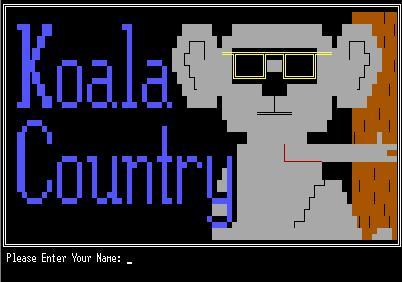
Koala Country BBS Login Screen — A typical BBS greeted users with an ANSI art splash screen. Sysops spent hours crafting these to make their boards look distinctive. First impressions mattered.
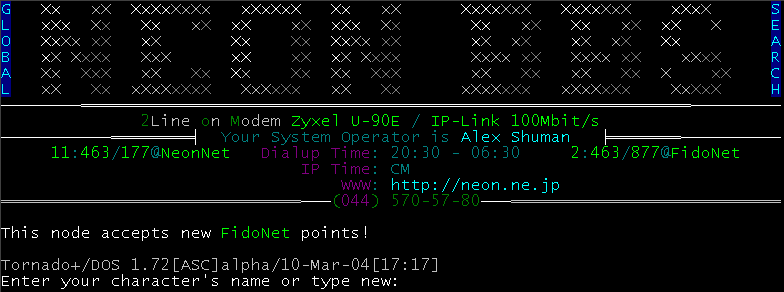
BBS Terminal Interface (Neon #2 BBS) — A classic text-based BBS menu. Options typically included message boards, file libraries, door games, bulletins, and the user list. Everything navigated by typing single characters.
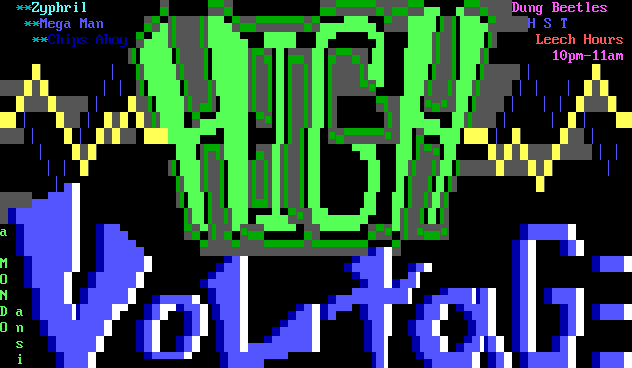
ANSI Art — Artists used the 16-color ANSI escape code character set to create elaborate graphics that rendered in terminal emulators. ANSI art groups like ACiD and iCE distributed art packs across the BBS network monthly.
The FidoNews
Every week, the FidoNews — a plaintext electronic newsletter — was distributed
across the entire FidoNet via FileEcho. It contained technical announcements, policy discussions,
humor, letters, node statistics, and op-ed pieces written by sysops. FidoNews was the town square
of the FidoNet community, and reading it was how you stayed connected to the global network's
happenings. Issues are archived and still readable today.
Dozens of BBS software packages existed, most of them implementing FidoNet compatibility.
Choosing your BBS software was a serious decision — some were commercial products, others
were freeware, and each had different file transfer protocols, door game interfaces,
and configuration complexity.
Fido BBS
Tom Jennings' original. DOS. Simple and reliable.
PCBoard
Commercial powerhouse. High-traffic systems. $$$.
RemoteAccess
Shareware. Very popular in Europe. Highly configurable.
Maximus
Free/open source. Ran on OS/2. Technically excellent.
TBBS
Multi-line commercial system. Big boards ran this.
Wildcat!
Windows-based. Easy to set up. Beginner-friendly.
Telegard
Freeware PCBoard-clone. Popular in early 1990s.
Renegade
Telegard fork. Highly customizable menus.
Synchronet
Survived into the internet era. Still active today.
SpitFire
Single-user. Fast and simple. Very low memory use.
RBBS-PC
One of the earliest. Written in BASIC. Widely forked.
WWIV
Source code distributed freely. WWIV-Net spinoff.
Door Games
One of the beloved features of BBSs was door games — external programs that users
could run through the BBS. The BBS would "drop to" the door program, passing the user's connection
through a serial "drop file," then resume when the game exited. Legendary door games included
Trade Wars 2002 (space trading), Legend of the Red Dragon (RPG),
Usurper (dungeon crawler), and Barren Realms Elite (strategy).
High scores persisted between sessions, and many had inter-BBS competitive modes via FidoNet.
Modems: The Hardware of FidoNet
Hayes Smartmodem (1982) — The modem that defined the era. Its AT command set let software control dialing, answering, and hanging up. At 300 baud, downloading a single floppy disk's worth of data could take hours.
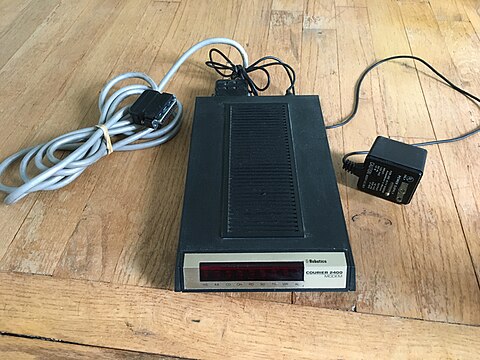
USRobotics Courier 2400 — By the late 1980s, 2400 baud was the FidoNet standard. USRobotics became the preferred brand for serious sysops. The Courier HST and Dual Standard later pushed to 9600 and 14.4k baud.
Acoustic Coupler — Before direct-connect modems were common, acoustic couplers clamped around telephone handsets. You literally held the phone in a cradle to transmit data. Maximum speed: 300 baud.
Legacy & Impact
How FidoNet shaped the internet we know today
FidoNet was not just a historical curiosity — it was a proof of concept that
a global, decentralized communications network could be built and run entirely by volunteers,
without corporate ownership, without central servers, and without charging users anything.
It anticipated concepts that the internet would later formalize, and many of its architects
went on to shape the early commercial internet.
FidoNet (1984)
Store-and-forward messagingMail queued and forwarded hop-by-hop
Hierarchical addressing (Zone:Net/Node)Structured like a postal code
Distributed node listPublished weekly, shared across network
Conference messaging (Echomail)Subscribe to topics, propagates everywhere
File distribution (FileEcho)Binary files propagated like messages
Volunteer-run, no central authorityPolicy 4: "What is is what is"
Poll-based transferNodes call each other on schedule
ZMH (Zone Mail Hour)Network maintenance window
The Internet / Email
SMTP store-and-forwardEmail relayed MTA-to-MTA
DNS + IP addressingHierarchical domain name system
DNS root servers + BGP tablesDistributed routing information
Usenet / mailing lists / forumsSubscribe, post propagates to all
FTP / HTTP file serversPush and pull file distribution
Persistent TCP connectionsReal-time push when online
BGP maintenance windowsScheduled downtime for routing
What FidoNet Invented First
Store-and-Forward Email
FidoNet's Netmail (1984) is functionally identical to SMTP email — addressed messages relayed hop-by-hop through a hierarchy of servers — but ran on phone lines instead of TCP/IP.
Online Discussion Groups
Echomail (1987) predates the public web's discussion boards and is directly comparable to Usenet, with subscribe/propagate semantics and threaded replies.
Distributed File Sharing
FileEcho propagated shareware, games, and utilities across the global BBS network automatically — a content distribution network run by volunteers years before Napster or BitTorrent.
Open Standards, Volunteer Governance
FidoNet's FSP (FidoNet Standards Proposals) process was a direct precursor to the IETF RFC process. Technical standards decided by rough consensus among implementers.
Internet Gateways
As early as 1989, gateways existed between FidoNet Echomail and Usenet newsgroups — bridging the two largest pre-web networks. Some users never knew which network they were "really" on.
Point Systems = Home Users
FidoNet Points (1988–89) let home users receive mail through a boss node without running 24/7 — the same model as dial-up ISP email accounts, a full decade earlier.
"FidoNet was essentially email, mailing lists, newsgroups, and file sharing — all running without the internet, without servers, without anyone being in charge. It worked because people wanted it to work."
— Description of FidoNet's functional equivalence to internet services
FidoNet Today
FidoNet is still alive. As of 2024, the network publishes a weekly nodelist with roughly
2,000–3,000 active nodes, most connecting via Binkp over TCP/IP rather than
modem dial-up. Active Echomail conferences include retro computing discussion, programming,
and nostalgia groups. The Synchronet BBS software has a built-in FidoNet mailer,
and new BBSs come online every year.
For anyone who wants to experience it: you can Telnet to many active BBSs today
(try bbs.synchro.net on port 23), join Echomail conferences, and exchange
Netmail with sysops around the world — the same way people did in 1991, just over
the internet instead of a phone line.
Further Reading
FidoNet Policy Document 4
The governing document of FidoNet. Famous for its pragmatic philosophy: "Sysops can do whatever they want as long as they don't screw up the mail." Still the foundation of FidoNet governance.
FTSC (FidoNet Technical Standards Committee)
The body that maintains FidoNet technical standards. All protocol specifications — packet formats, mailer handshakes, nodelist formats — are documented in freely available FSP documents.
BBS Documentary (2005)
Jason Scott's multi-hour documentary on the BBS era covers FidoNet extensively. Includes interviews with Tom Jennings and dozens of sysops. Freely available online.
Seth Able Robinson · 1989 – 1995 · The most-played door game in BBS history
1989Created
12Max Level
5Fights / Day
4.06cFinal Version
$30Registration
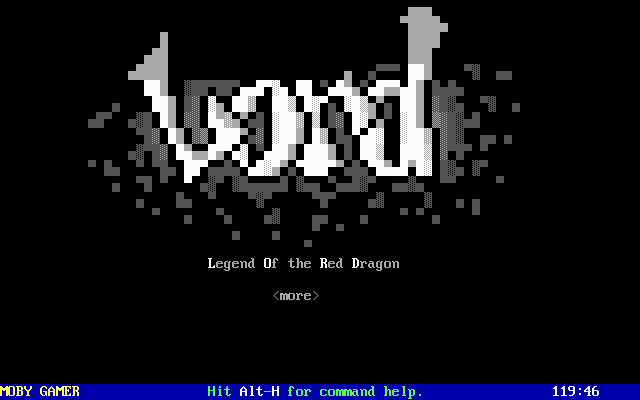
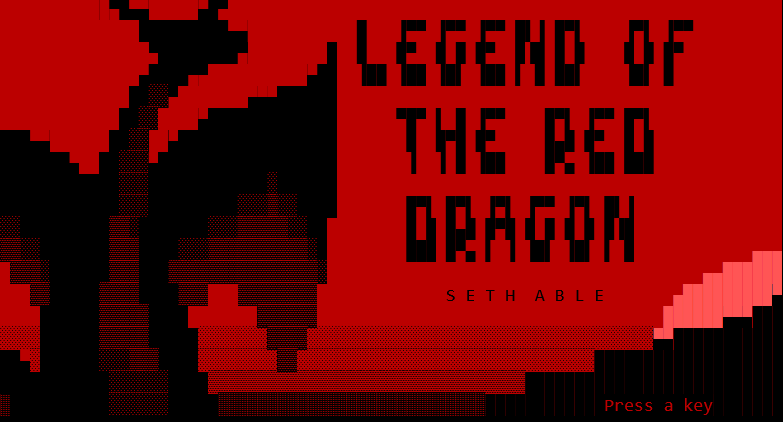
The LORD splash screen — the first thing you saw when the door loaded from the BBS
The main menu in its ANSI glory — Enter the realm, list warriors, or quit back to BBS
In 1989, a teenager named Seth Robinson — posting under the handle Seth Able —
wrote a game for bulletin board systems that would define an era. Legend of the Red Dragon
was a text-based multiplayer RPG, delivered as a "door program": the BBS would shell out to it,
hand off the caller's connection, and LORD would take over.
What made it extraordinary wasn't just the combat — it was that every player on the same BBS
shared a single persistent world. The gold you earned stayed yours. The players you killed stayed dead
(for the day). The person who seduced Violet at the tavern was a real user on your system.
In a world without the internet, this was shared online gaming.
Seth Able Robinson
Seth Able Robinson
Creator of LORD · BBS Door Game Legend
Robinson began writing LORD at age 17, releasing version 1.0 in 1989 from his home in Canada.
The game spread virally through the BBS network — sysops downloaded it, installed it, and
players demanded it on every board they called. At its peak, LORD ran on tens of thousands of BBSs simultaneously.
He embedded himself in the game as Seth Able, an unkillable Death Knight
who appears when a player reaches level 12 — the final challenge before the Red Dragon itself.
Registration ($30) unlocked the full game; Robinson used the revenue to fund continued development
through version 4.06c, the final and most-polished release.
He later wrote LORD 2: New World, Planets: The Eminent Olympians, and several
other door games. In the 2000s he transitioned to commercial game development, but LORD remains
his most enduring creation — still playable today on modern BBS revival networks.
How Door Games Worked
LORD was a door program — an external application that the BBS software could shell out to.
When you typed D for Doors and selected LORD, Wildcat (or PCBoard, TBBS, etc.) would write a
DOOR.SYS file containing your connection details — name, baud rate, security level, time remaining —
then execute LORD.EXE, passing it that file. LORD would read your character from its own LORD.DAT
database, run your session, save changes, and exit back to the BBS.
This meant that while your session was real-time, other players' actions you saw (kills, messages,
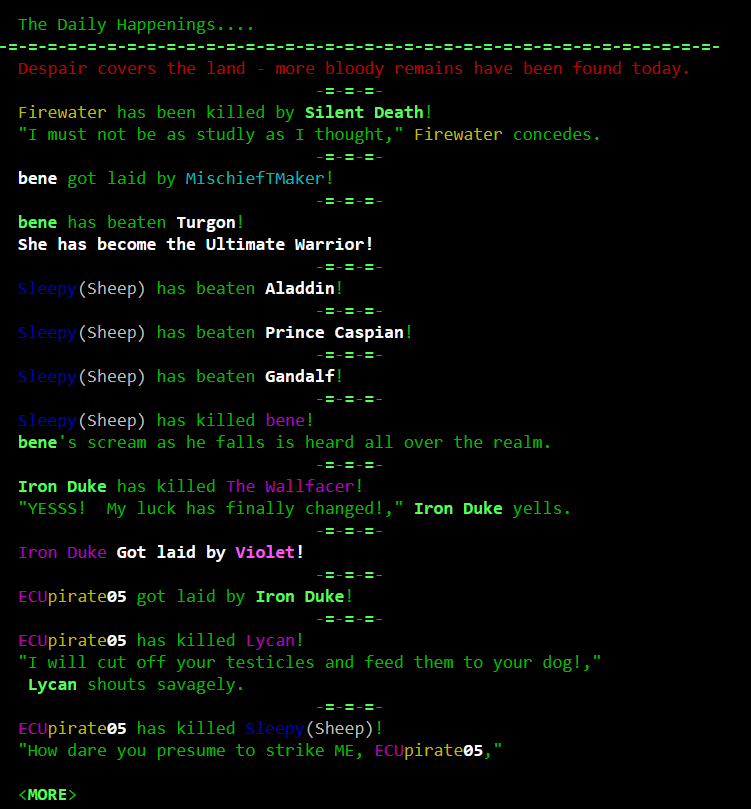
marriages) had happened in prior sessions. LORD printed a "Daily News" each morning summarizing what happened
overnight: who leveled up, who killed whom, who married Violet. It was asynchronous multiplayer before anyone
had a word for it.
Writing DOOR.SYS ... OK
Dropping to LORD.EXE ...
LORD reads your record from LORD.DAT:
Name : SNAKE PLISSKEN
Level : 4
HP : 325 / 325
Gold : 4,820
Fights : 5 remaining today
Killed : Nobody yet today
Session begins. Changes are saved when you quit or your time runs out.
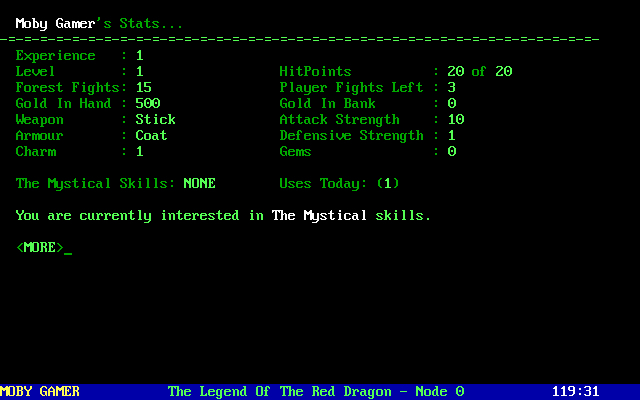
Your stats at level 1 — experience, HP, gold, weapon, armour, charm, and gems all in one view
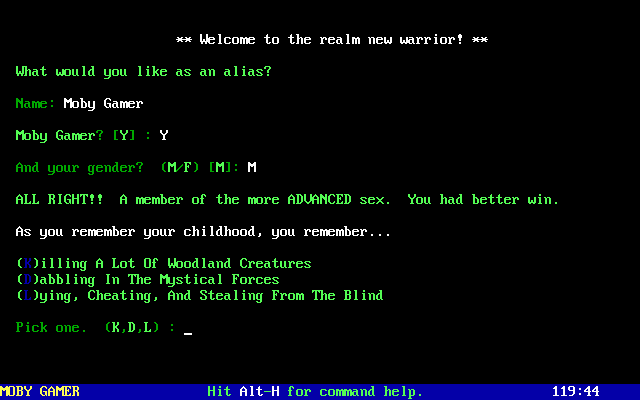
Choosing your path: killing woodland creatures (warrior), mystical forces (mage), or lying and stealing (thief)
The Legend
The kingdom of Hamm is gripped by terror. A Red Dragon of ancient and terrible power
has claimed the realm, demanding tribute and spreading destruction. The king has called for a champion —
anyone brave (or foolish) enough to face the beast.
You start as a level 1 adventurer with a rusty sword and a handful of gold. Each day you venture into
the Dark Forest surrounding the town — fighting monsters, gathering experience,
buying better weapons, growing stronger. Twelve levels stand between you and the dragon.
Along the way you may love, be betrayed, make enemies, and leave your name in the Daily News.
Daily News — Day 47────────────────────────────────────────────HEXMASTER has reached level 7! The realm trembles.
SNAKE PLISSKEN slew a Dark Elf in the forest (+280 xp).
VIOLET was seen walking with DARKSTAR in the garden.
The Red Dragon was sighted near the eastern pass. Beware.
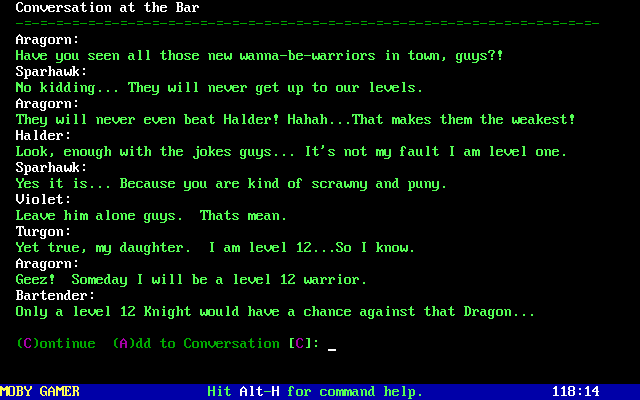
Overheard at the bar — Violet, Turgon, Aragorn, and fellow adventurers discuss the Dragon and each other
The Daily Happenings — every session began by catching up on who killed whom, who leveled up, who married whom
The Dark Forest
Each day you get 5 forest fights. Enter the forest, face a random monster matched
roughly to your level, fight it out in turns: attack, run, or spend a gem for a powerful strike.
Victory brings experience and gold. Death at low levels costs you a day; at higher levels other players
can steal your corpse's gold. Used all 5 fights? Come back tomorrow.
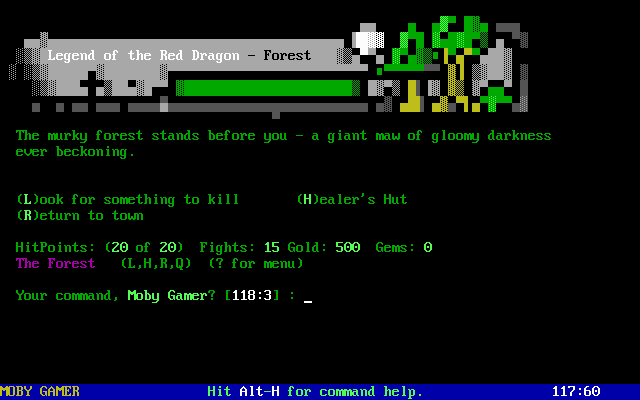
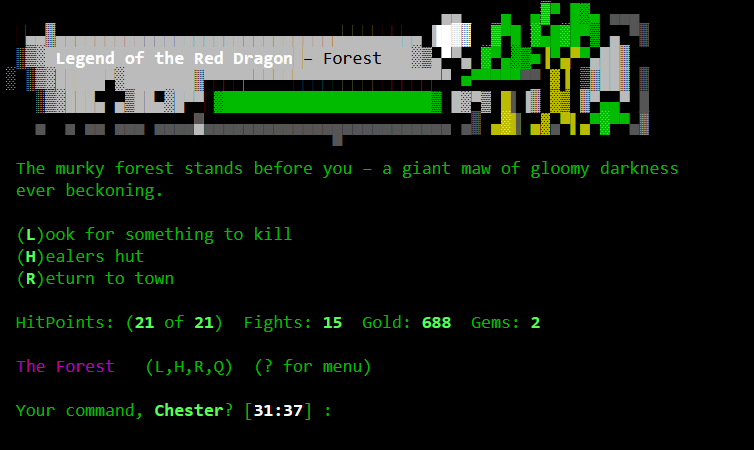
Entering the Dark Forest — RIP (Remote Imaging Protocol) graphics drew pixel art on supporting terminals. "The murky forest stands before you — a giant maw of gloomy darkness ever beckoning."
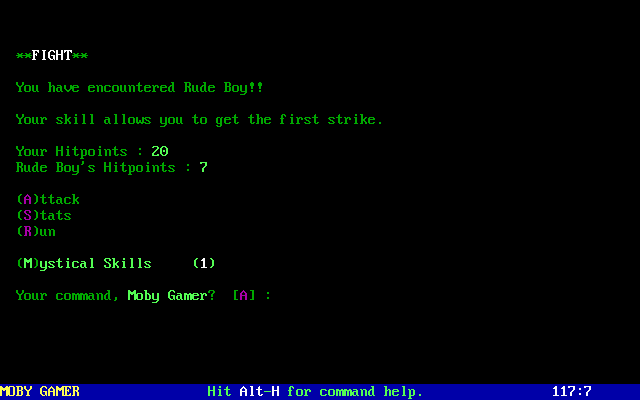
A fight in the forest — your HP, the monster's HP, and three choices: Attack, Stats, or Run
Lv
Monster
HP Range
EXP
Gold
Notes
1
Slime
10 – 22
8 – 16
4 – 10
First enemy new players see
1
Beggar
8 – 18
10 – 20
3 – 8
May beg for mercy mid-fight
2
Ragged Boy
28 – 48
35 – 60
14 – 28
First foe to talk back
2
Giant Moth
32 – 55
40 – 65
12 – 22
Blinds on critical hits
3
Giant Spider
65 – 110
85 – 130
40 – 75
Common mid-game target
3
Drunk
55 – 90
70 – 110
55 – 90
High gold drop for level
4
Dark Elf
130 – 205
160 – 250
80 – 150
Casts minor spells
4
Half Troll
155 – 230
185 – 270
70 – 140
High defense
5
Werewolf
255 – 390
315 – 460
130 – 230
Fast; extra attack chance
5
Barbarian
270 – 410
335 – 490
120 – 210
Can steal a gem
6–7
Forest Demon
410 – 620
510 – 760
255 – 420
Resists gem attacks
8–9
Black Knight
620 – 940
760 – 1,150
420 – 680
Can call for help
10–11
Dragon Hatchling
950 – 1,450
1,150 – 1,750
620 – 980
Breathes fire; high XP
Combat
Combat is turn-based: you act, the monster acts, repeat until one side dies or flees.
Each turn you choose (A)ttack, (R)un, or (U)se a gem.
Gems deal massive damage — roughly 3× a normal hit — but you carry only a handful.
Running succeeds based on your level vs. the monster's; failing costs you a turn of free hits.
Critical hits occur randomly and can be decisive in tough fights.
You attack the WEREWOLF with your blade! *** You hit the WEREWOLF for 74 damage! [Werewolf HP: 188] The WEREWOLF slashes back with razor claws! *** The WEREWOLF hits you for 38 damage! [Your HP: 247/325] (A)ttack (R)un (U)se a gem :U You hurl a crackling GEM at the WEREWOLF! *** MAGICAL STRIKE — 198 damage! — KILLING BLOW! *** The WEREWOLF is DEAD! *** You gained 412 experience! You found 178 gold pieces!
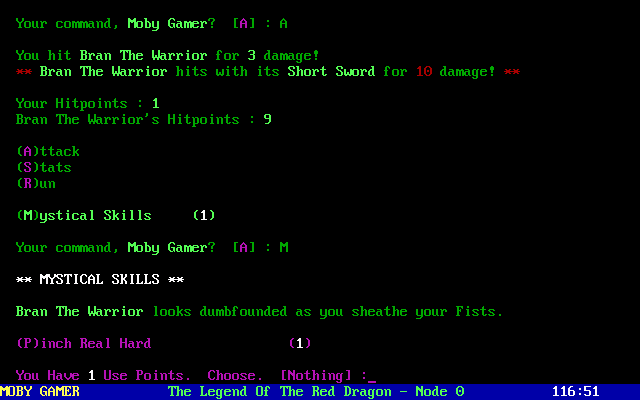
Mystical Skills — mage-path players could unleash special abilities mid-fight, like "Pinch Real Hard"
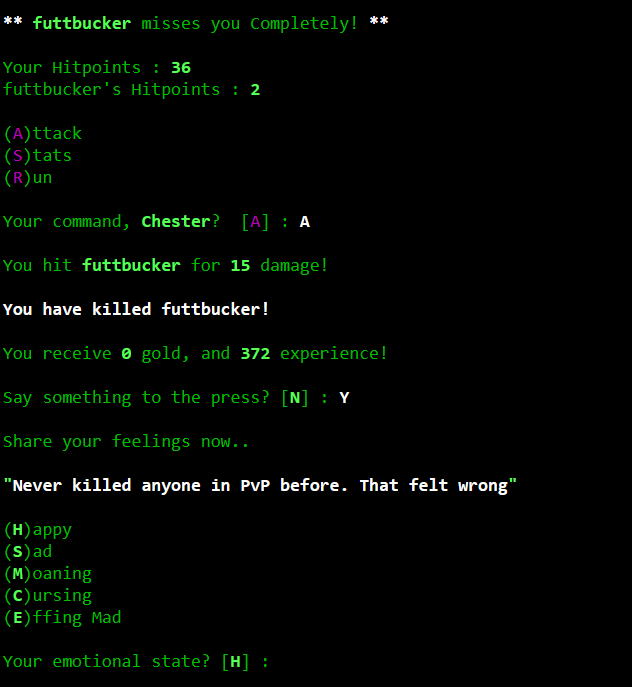
Player vs. player combat — challenge another warrior directly; winner takes their gold
The Town of Hamm
Between forest runs you return to town. Each location serves a distinct purpose —
and some conceal surprises, player interactions, and story events.
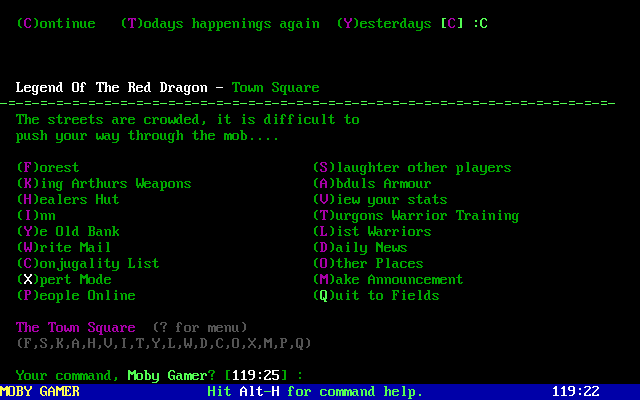
The Town Square — every location in Hamm accessible from a single menu. The streets are crowded; it is difficult to push your way through the mob.
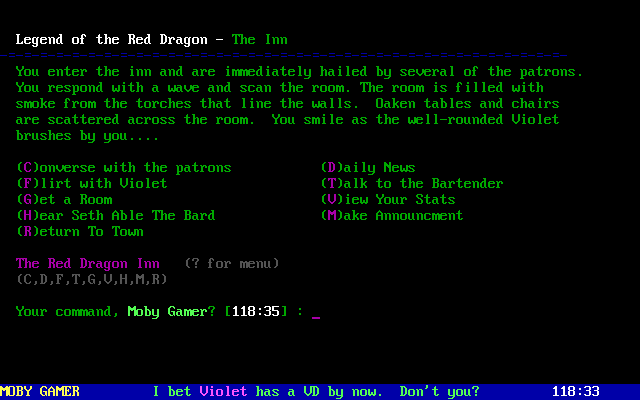
The Red Dragon Inn — "You smile as the well-rounded Violet brushes by you." Flirt, drink, hear Seth Able sing, or read the Daily News.
🍺
The Golden Dragon Inn
Drink ale to restore HP. Flirt with Violet. Gamble for gold. Share tales of the forest with other players. The social heart of Hamm.
⚔
Armoury
Buy better weapons and armor. Each tier improves your attack damage and damage reduction. Investing here is the fastest route to surviving higher-level monsters.
💊
The Healer — Turgon
Turgon restores your HP for gold. Costs scale with how much HP you need. Essential after a brutal forest session if you want to fight again same day.
💎
The Gem Shop
Buy gems to use in combat for massive damage. Carry up to 3. Expensive but can turn a losing fight. Essential for boss encounters.
⚔
Player Combat
Challenge other players directly — once per day. If you win you steal their gold. If you lose they get yours. High risk, high reward. Player kills raise your prestige.
💌
The Marriage Parlor
Marry another player character. Spouses share benefits and can leave messages for each other. Divorce is possible but expensive. A surprisingly popular feature.
🌹
The Garden
Meet other players who are currently online (or have been recently). Leave flowers. The game's nod to social networking, 20 years before Facebook.
📜
The Daily News
Every morning a fresh bulletin summarizes overnight events: level-ups, kills, marriages, forest records. Read it first thing — it tells you who to fear and who to challenge.
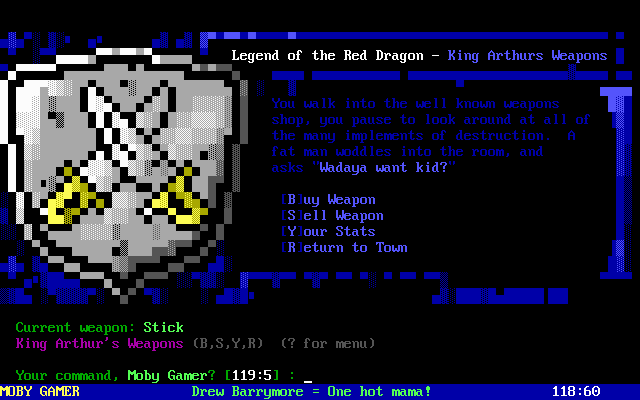
King Arthur's Weapons — RIP graphics drew a pixel shield; the fat shopkeeper waddles in: "Wadaya want kid?"
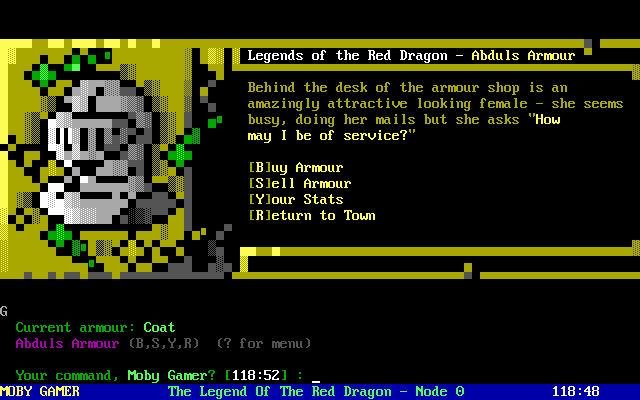
Abdul's Armour — a knight stands watch; behind the desk "an amazingly attractive looking female" does her nails
Notable Characters
Violet
Barmaid · The Golden Dragon Inn
The emotional center of LORD. Violet is charming, warm, and fiercely loyal to whoever wins her affection.
Your Charm stat determines how she responds to your overtures. Court her enough and she'll give
you free ale, extra HP, and messages that other players can see. You can even marry her — but other
players will compete for the same privilege. Her dialogue was famous for being genuinely witty.
Seth Able
The Death Knight · Level 12 Gatekeeper
Robinson's own avatar, embedded in the game as an easter egg turned legend. When a player reaches
level 12 — the doorstep of the Red Dragon — Seth Able challenges them to single combat.
He is extraordinarily powerful: huge HP, devastating attacks. Killing him is a badge of honor that
the game announces to all players. The first person on each BBS to reach level 12 gets
a permanent title in the Daily News.
The Old Man
Wandering Sage · Random Event
Appears randomly during forest trips or town visits. Sometimes gives gold or gems;
sometimes offers cryptic advice about the Dragon; occasionally tricks you out of money.
His appearances were random enough that encountering him felt like a genuine surprise,
and his dialogue rotated — players shared his best lines on BBSs across the country.
The Bard
Inn Entertainer · Story Repository
Sits in the inn singing of past heroes. His songs are dynamically generated from the server's
player history — he actually sings about the kills and achievements of players on your BBS.
Hearing your own name in a bard's song was a mark of status that players actively sought.
The Red Dragon
Final Boss · Ancient Terror
The endgame. Accessible only at level 12, after defeating Seth Able. The Dragon has
massive HP and deals catastrophic damage. Defeating it resets the server — everyone drops
back to level 1, the Dragon is reborn, and the champion's name is inscribed permanently
in the game's Hall of Fame. Killing the Dragon was the highest achievement possible.
Turgon
Town Healer
The healer who restores HP for gold. Practical and mercenary — he has no interest in your
adventures, only your coin. His prices scale with damage, making healing after tough fights
a meaningful financial decision. A key part of the resource management that gave LORD its
strategic depth.
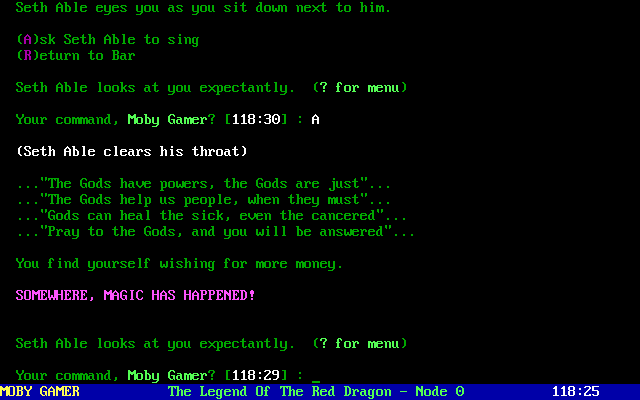
Seth Able clears his throat and sings — "The Gods have powers, the Gods are just..." Somewhere, magic has happened.
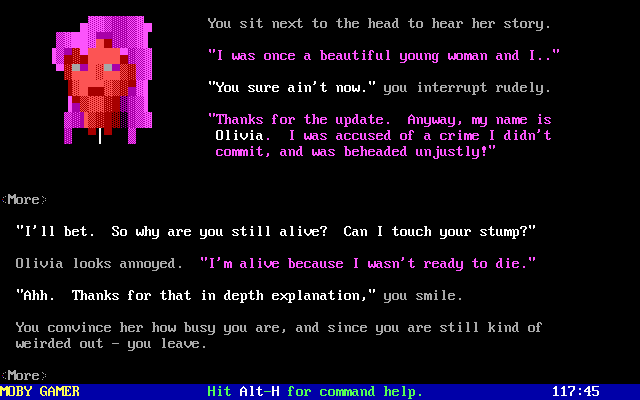
Olivia — a random forest event. A severed head tells her tale. LORD's humor was dark and unforgettable.
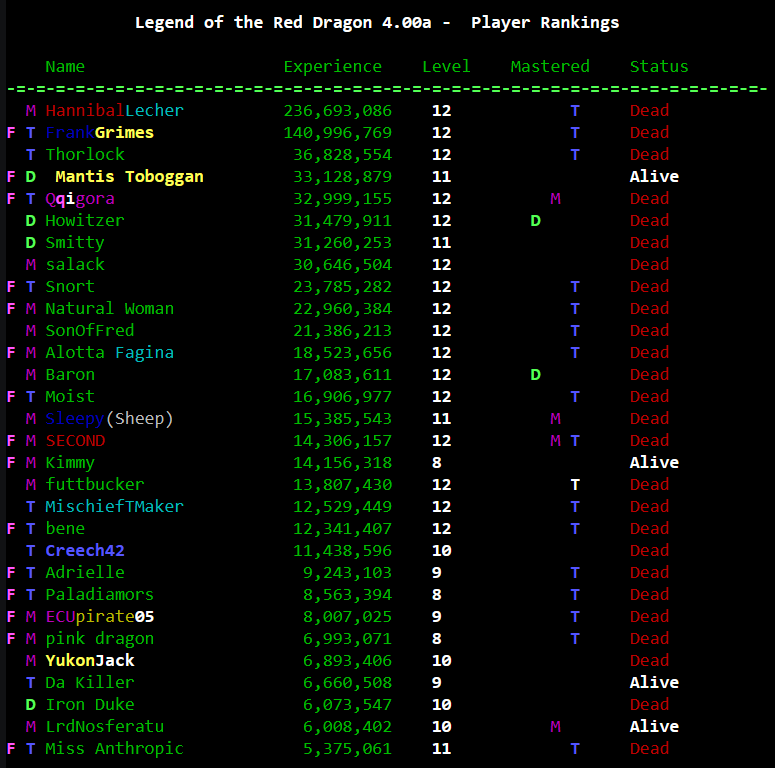
The warrior rankings — your standing visible to every player on the BBS. Staying #1 was the real game.
The Road to Level 12
LORD's leveling is exponential — early levels come quickly, later ones require dedicated sessions
across many days. Each level raises your max HP, attack power, and defense. The experience curve
was tuned so that an active player might reach level 6–7 in a week of playing; level 12 took
commitment, luck, and surviving player attacks.
Level 1 – 3
Novice
Slimes and Beggars. Scraping for gold. Buying your first real weapon. Learning that running from a fight isn't cowardice — it's survival. The most dangerous time: other players can kill you for easy early XP.
Level 4 – 6
Adventurer
Dark Elves and Werewolves. Meaningful gold flow. You can now afford Turgon regularly and start carrying gems. Violet starts noticing you. Player kills become tempting — and terrifying.
Level 7 – 9
Warrior
Forest Demons and Black Knights. You're formidable but not invincible. Your name appears in the Daily News regularly. Marriages become diplomatically interesting. Other high-level players become your primary threat.
Level 10 – 11
Champion
Dragon Hatchlings. Massive XP hauls. The whole BBS is watching. You can one-shot most players. One bad fight in the forest or a surprise player attack can end your run. Every session matters.
Level 12
Legend
Seth Able awaits. Defeat him, face the Red Dragon. If you win, you reset the entire server and your name is written into LORD's Hall of Fame — permanent, visible to everyone, forever.
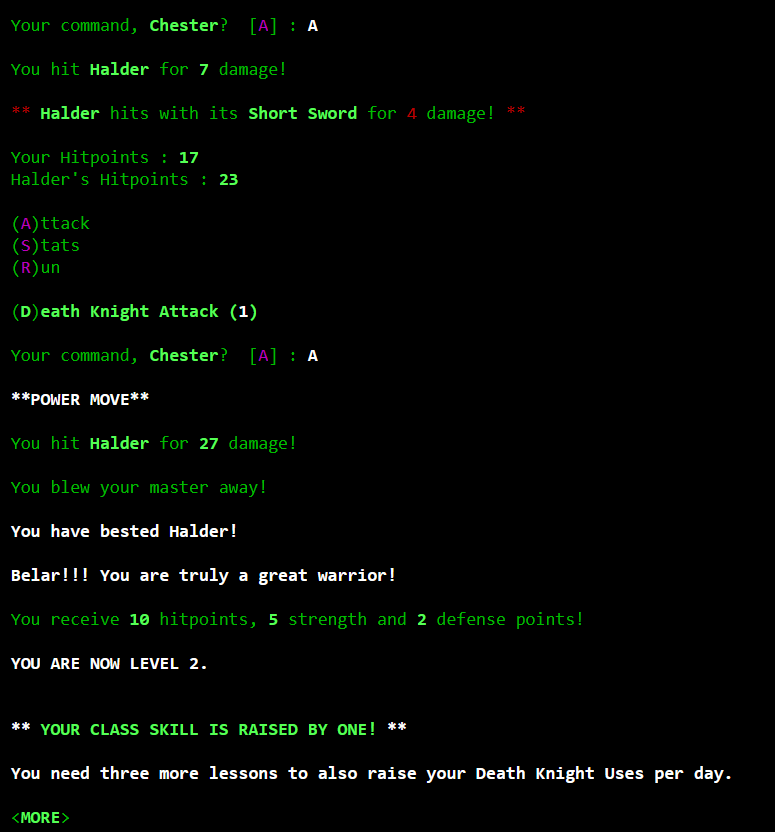
Leveling up — your stats climb, a fanfare plays, and everyone on the BBS sees your name in tomorrow's Daily News
Turgon the Healer — restore HP for gold. At high levels, keeping yourself alive between fights was a significant expense.
Legacy
LORD pioneered mechanics that would define online gaming for decades: daily action limits as progression
pacing, player-vs-player with real stakes, shared persistent world state, and asynchronous social systems
(the Daily News, the Bard). These patterns appear today in idle games, mobile RPGs, and MMO daily quests
— usually without credit to their origin.
The game survives on BBS revival networks like Telnet BBS Guide and FOSSANET, where LORD servers still
run and players still race to kill the Dragon. Seth Able Robinson open-sourced LORD in later years,
spawning dozens of mods and successors. The original LORD.DAT binary format has been
reverse-engineered and reimplemented in multiple languages.
If you called a BBS in the early 1990s, you played LORD. If you played LORD, you remember it.
Few games have ever produced that particular mixture of competition, romance, humor, and dread —
the feeling of logging in each morning to read the Daily News and discovering what happened while you slept.
BBS Simulator
Dial into Wildcat! BBS — play Legend of the Red Dragon — live the 1990s
Experience what it felt like to dial up a bulletin board system in 1993.
Watch the modem connect, log into Wildcat! BBS, navigate the menus,
shell out to the classic door game Legend of the Red Dragon (LORD),
fight monsters in the Dark Forest, and flirt with Violet the barmaid.